Recreational training
Underwater Photography
Taking photographs that are worth keeping — which starts with buoyancy, not with a camera.
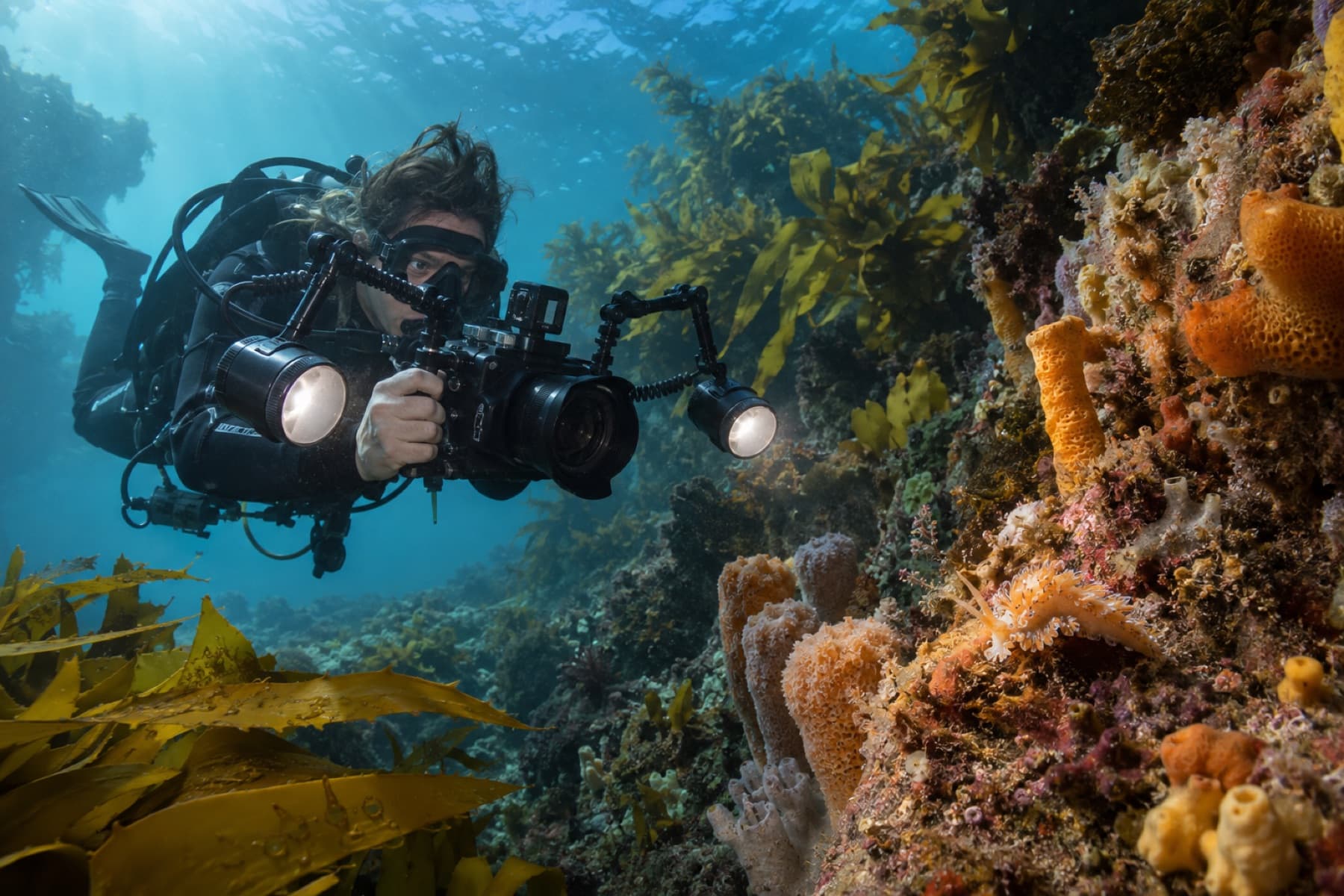
Underwater photography is a large part of why many people keep diving, and Australia's temperate sites in particular reward it: seadragons, cuttlefish, sponge gardens and macro life that exists nowhere else.
The course covers the things water does to light — colour loss with depth, backscatter from particles, and the fact that getting closer solves more problems than any equipment upgrade.
The uncomfortable truth it also teaches is that buoyancy control matters more than the camera. A diver who cannot hold position cannot photograph a subject without destroying the visibility first.
| Track | Recreational |
|---|---|
| Prerequisites | Open Water Diver certification; Peak Performance Buoyancy strongly recommended |
| Agency equivalents | PADI: Digital Underwater Photographer · SSI: Photo & Video |
- colour loss with depth and correcting it
- strobe and video light positioning to avoid backscatter
- getting close and reducing the water between lens and subject
- composition and shooting angle
- camera settings for macro and wide angle
- approaching marine life without disturbing it
A photographer who cannot hold a stable position will stir sediment, destroy visibility for themselves and everyone else, and damage the habitat they came to photograph.
Peak Performance Buoyancy before a photography course produces better results than the reverse order.
Weedy and leafy seadragons, seahorses and handfish are protected, slow-moving and easily stressed by crowding and repeated strobe flashes.
Limit time per animal, keep a respectful distance and never move or handle a subject to improve a shot. A photograph is not worth the animal's stress.
Where this qualification matters in Australia
Sites where holding this certification genuinely changes what you can do — not a list of everywhere it is accepted.
Natural next steps
Courses that build directly on this one.
Courses that lead here
Agency versions of this course
The same qualification under different names. All are mutually recognised by operators.
Centres documented as offering this level of training
Businesses where the relevant capability is verified or advertised. Always confirm the specific course directly.
Frequently asked questions
Do I need an expensive camera?
No. Technique, proximity and lighting matter far more than the body. Many excellent underwater photographs are taken on compact cameras.
Why are my photos blue and washed out?
Water absorbs red light quickly. Getting closer, using a strobe or video light, and shooting shallower all restore colour.
What is backscatter?
Light from your strobe reflecting off particles between the lens and the subject. Moving strobes outward and getting closer to the subject are the standard fixes.