Recreational training
Advanced Open Water Diver
Five guided specialty dives that extend depth to 30 metres and introduce navigation and other skills.
Advanced Open Water is usually the second certification a diver takes, and its name is somewhat misleading — it is an introduction to a range of diving types rather than an advanced qualification.
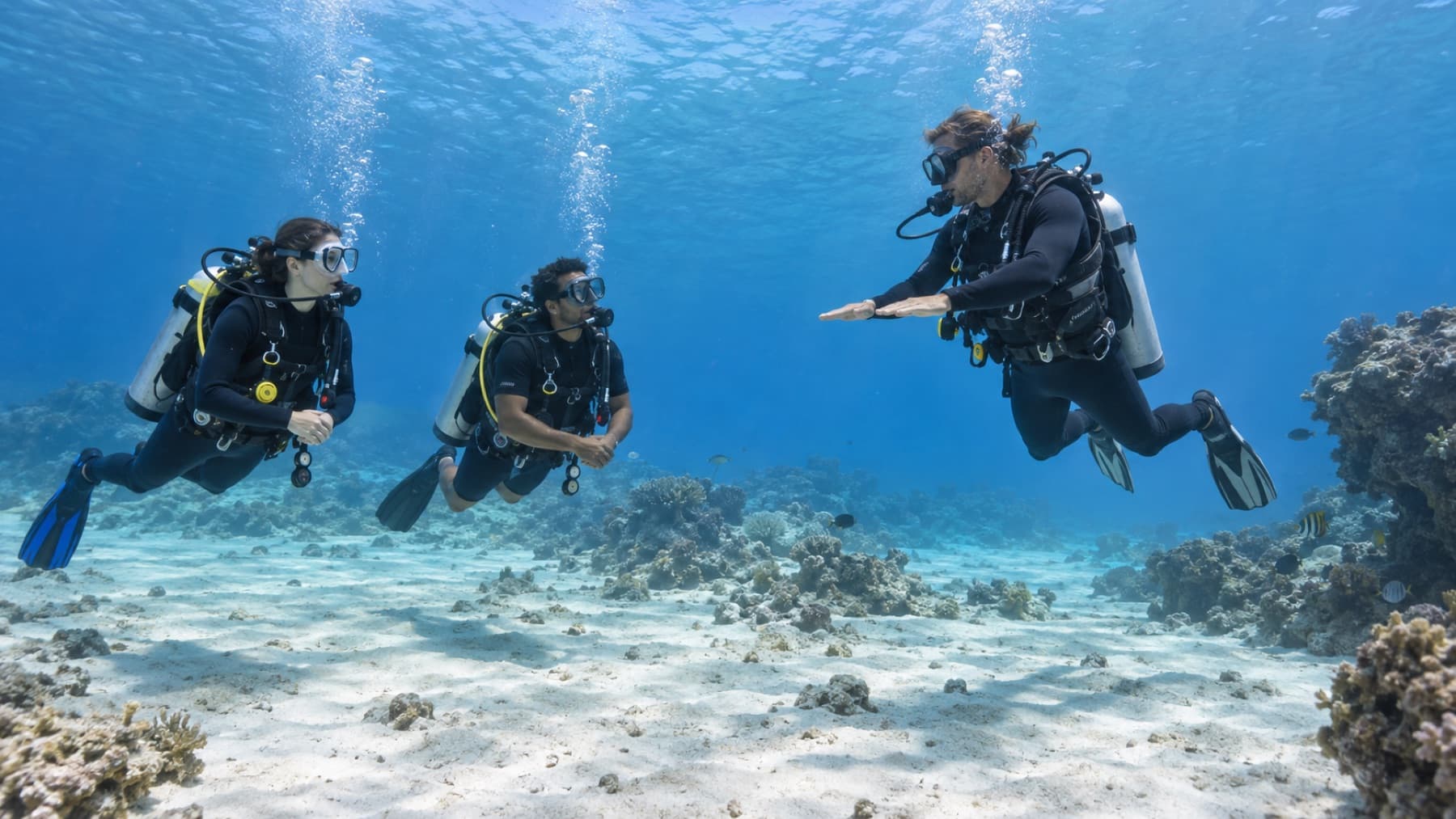
The course typically consists of five dives: a deep dive, a navigation dive and three elective adventure dives chosen from specialties such as night, wreck, drysuit, photography or peak performance buoyancy.
Its practical value is that it extends the recreational depth limit to around 30 metres, which opens up a large proportion of Australia's better dive sites — including most of the wrecks and offshore sites.
| Track | Recreational |
|---|---|
| Prerequisites | Open Water Diver certification; Minimum age (typically 12–15 depending on agency) |
| Agency equivalents | PADI: Advanced Open Water Diver · SSI: Advanced Adventurer · SDI: Advanced Adventure Diver · RAID: Explorer 30 |
- diving to around 30 metres with appropriate planning
- underwater navigation with compass and natural references
- gas management at greater depth
- narcosis awareness
- an introduction to several specialty disciplines
A great many of Australia's signature dives sit between 18 and 30 metres: the SS Yongala, HMAS Canberra, the ex-HMAS Brisbane, Wolf Rock, Flat Rock and the deeper Solitary Islands sites among them.
Without this certification, a substantial part of Australian diving is simply unavailable, which is why it is the most commonly taken second course in the country.
The three elective dives are frequently chosen by whatever the centre is running that weekend. Choosing them around the diving you actually intend to do is more useful.
A Victorian or Tasmanian diver benefits enormously from the drysuit dive. A diver heading to Queensland wrecks benefits from the wreck dive. A photographer benefits from buoyancy far more than from a photography module.
Where this qualification matters in Australia
Sites where holding this certification genuinely changes what you can do — not a list of everywhere it is accepted.
Natural next steps
Courses that build directly on this one.
Courses that lead here
Agency versions of this course
The same qualification under different names. All are mutually recognised by operators.
Centres documented as offering this level of training
Businesses where the relevant capability is verified or advertised. Always confirm the specific course directly.
Frequently asked questions
Is Advanced Open Water actually advanced?
Not in the technical sense. It is a supervised introduction to several diving types, and it extends your depth limit. It does not make you an experienced diver.
How many dives do I need first?
Most agencies allow it immediately after Open Water. Many instructors suggest logging some dives first, so the course builds on comfort rather than substituting for it.
Do I need it for the SS Yongala?
Operator requirements vary, but the depth makes it strongly advisable, and some operators require it along with a minimum number of logged dives.