Technical diving
Sidemount Diving
Cylinders at your sides — redundancy, streamlining and restriction access.
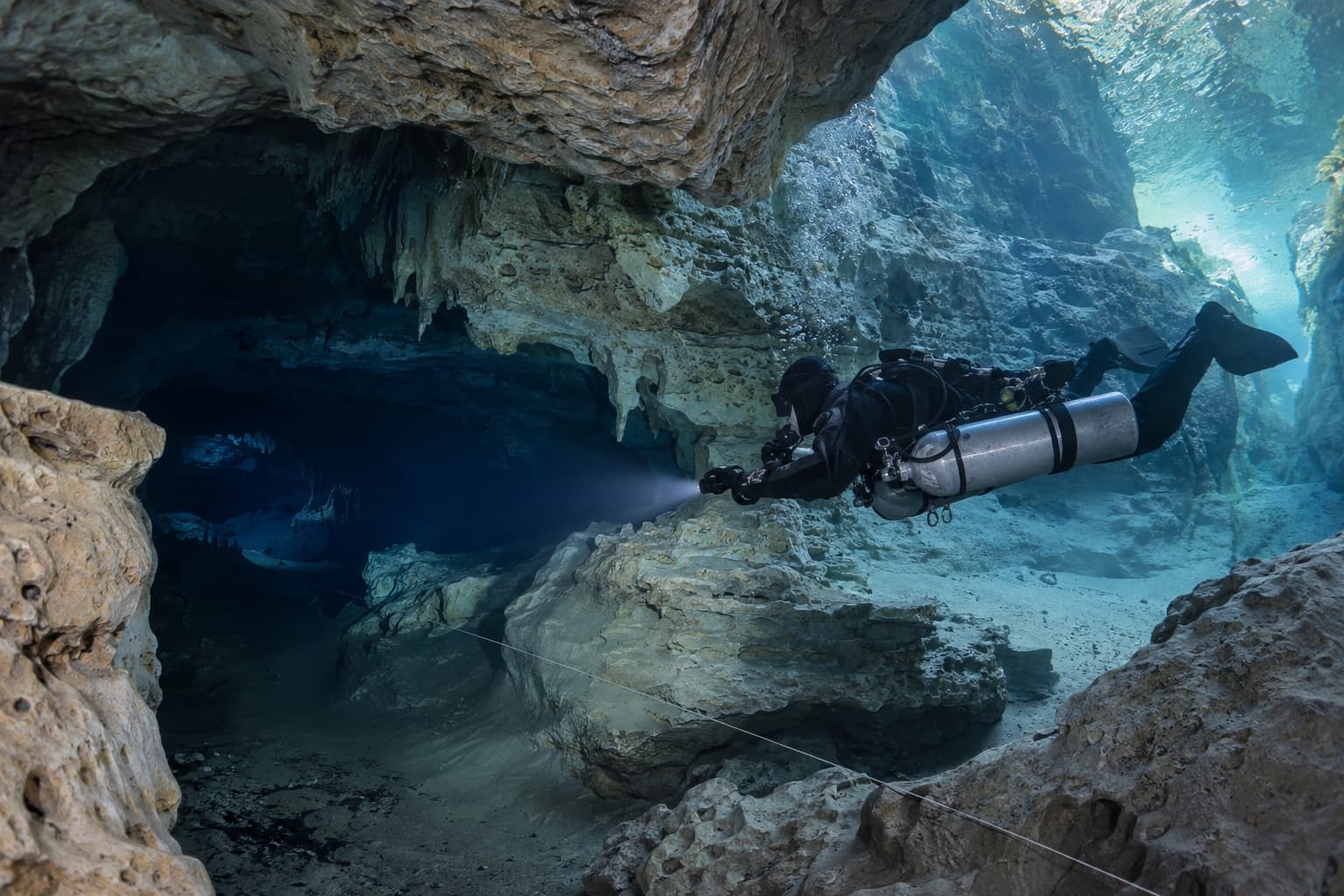
Sidemount mounts cylinders along the diver's sides rather than on the back, providing full gas redundancy with independent cylinders and a lower, more streamlined profile.
It originated in cave diving, where restrictions make backmounted twinsets impractical, and has since spread well beyond that context.
In Australia it is particularly relevant to the Mount Gambier cave systems, where restrictions in systems like Tank Cave make it a practical necessity rather than a preference.
Independent cylinders mean a failure costs half your gas rather than all of it. Cylinders can be removed and passed through a restriction. And carrying two cylinders separately to the water is considerably easier than one heavy twinset.
That last point is not trivial — for divers with back or shoulder problems it is often the deciding factor.
Sidemount harnesses and rigging differ considerably between systems and between instructors, and what works in a warm-water cave does not necessarily work in a Victorian drysuit.
Training with an instructor who dives the configuration in conditions like yours matters more than the specific brand of harness.
Related training
Where this applies in Australia
Frequently asked questions
Is sidemount better than backmount?
Neither is universally better. Sidemount excels in restrictions and for divers who find twinsets physically difficult; backmount twinsets remain common for open-water technical diving.
Can I hire sidemount equipment in Australia?
Availability is limited and concentrated in technical centres. Confirm before travelling rather than assuming.