Marine life
Leafy Seadragon
Phycodurus eques
South Australia's emblem and the most elaborately camouflaged fish in the world.
The leafy seadragon is found nowhere on earth except southern Australia, and seeing one is the single best reason for a diver to travel to South Australia.
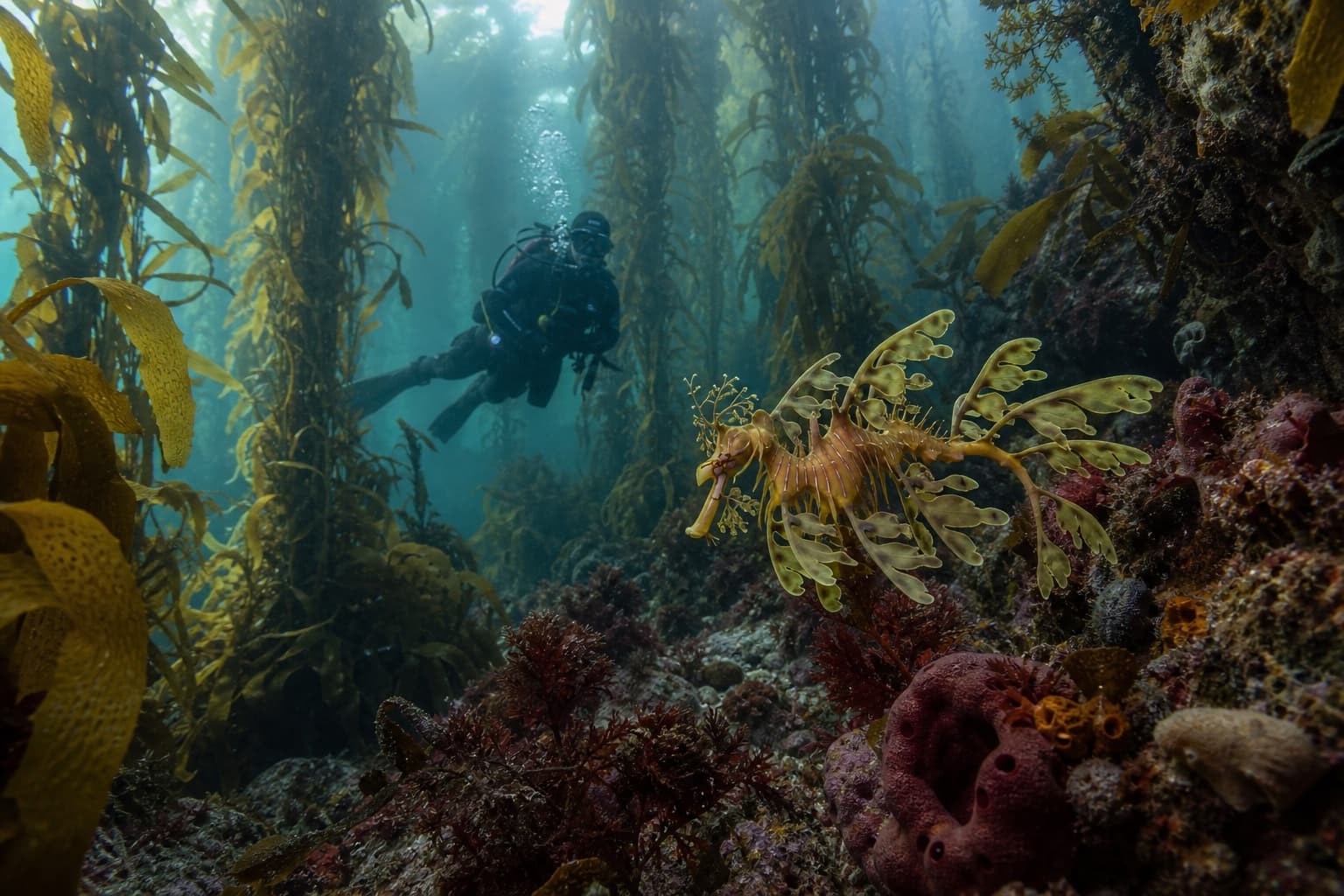
Its camouflage is not a pattern but a structure: leaf-shaped appendages growing from the body that mimic the drifting kelp it lives among. It does not swim so much as drift, propelled by two nearly invisible transparent fins, and the effect is a piece of weed that happens to have an eye.
Rapid Bay jetty on the Fleurieu Peninsula is the most famous site. Finding them takes slow, patient searching around structure and weed — divers who cover ground quickly see nothing, and divers who hover in one spot for ten minutes frequently find several.
| Scientific name | Phycodurus eques |
|---|---|
| Typical size | Commonly 20–35 cm |
| Conservation status | Protected in all Australian states where it occurs |
| Peak months | October, November |
| Documented sites | 4 |
| States | South Australia |
- olive to yellow-brown with elaborate leaf-shaped appendages
- long tubular snout
- drifts rather than swims; fins are nearly transparent
- no prehensile tail — unlike seahorses it cannot grip
- larger and far more ornate than the weedy seadragon
- Feeds on mysid shrimp, drawn in through the tubular snout.
- Males carry eggs on the underside of the tail, brooding them for roughly eight weeks.
- Moves very slowly and relies entirely on camouflage rather than flight.
Leafy seadragons are found by searching slowly and deliberately, not by swimming a circuit. Work the base of jetty piles, weed edges and reef margins at 4–10 metres.
Look for the eye and the snout rather than the shape — the body reads as weed, but the eye does not. Divers often find their first one only after someone points it out, and then find three more in the same dive.
In-water etiquette
Leafy Seadragon is protected in all australian states where it occurs. How divers behave around it genuinely matters.
- Never touch, move or handle — they are protected by law and easily stressed.
- Limit strobe flashes per animal; repeated firing at close range is harmful.
- Maintain buoyancy and keep fins clear of the bottom — silt ruins the site for everyone.
- Do not crowd. One diver at a time is the workable etiquette at busy sites.
Where to see them
Sites where this species is documented as a reliable encounter.
Operators servicing those sites
Businesses documented as diving the sites above. Confirm seasonality and requirements directly.
Often seen on the same dives
Frequently asked questions
Where can I see a leafy seadragon?
Rapid Bay jetty in South Australia is the best-known site. Second Valley, Edithburgh and a number of other South Australian and southern WA jetties also support them.
What is the difference between a leafy and a weedy seadragon?
Leafy seadragons are larger, yellow-brown and covered in elaborate leaf-like appendages. Weedy seadragons are more slender, reddish with yellow spots and blue bars, and far more widespread along the southern coast.
Are they hard to find?
They are superbly camouflaged but not rare at the right sites. Slow, patient searching around structure and weed is far more effective than covering distance.
Last researched: September 2026. Dive businesses change frequently — confirm current services, prices and requirements directly with the operator before booking.